
Tokyo’s Capsule Hotels: When a Bed Becomes Architecture
Walk through Tokyo late at night and you will find a city built around movement. Trains continue running late into the evening, convenience stores stay open around the clock, restaurants occupy tiny floors above busy streets, and entire neighbourhoods are designed around people arriving, leaving, working, eating and sleeping at different times.
Somewhere within this constant movement sits one of Japan’s most recognisable hospitality concepts: the capsule hotel.
The basic proposition is remarkably simple.
Instead of giving each guest a conventional hotel room, the hotel provides a compact sleeping capsule, while bathrooms, showers, lounges and other facilities are shared. The result is significantly more efficient use of space, but also a completely different idea of what a hotel room needs to be.
Although capsule hotels are now strongly associated with Tokyo, the concept actually began in Osaka. Capsule Inn Osaka opened in 1979 and was designed by architect Kisho Kurokawa, one of the leading figures of Japan’s Metabolist architectural movement. The capsules were manufactured as prefabricated units measuring approximately 190 centimetres long, 90 centimetres wide and 90 centimetres high. They contained the essentials required for sleeping, including lighting, a clock, radio and television.
The idea emerged from a very practical problem. The company behind Capsule Inn Osaka operated saunas and had observed customers sleeping in communal rest areas. Kurokawa had already developed the idea of capsule architecture, including his Capsule House concept presented at Expo ’70 in Osaka. The hotel transformed that architectural experiment into a commercial form of accommodation.
At the time, the concept was particularly suited to Japan’s urban business culture. A late night at work, drinking after hours or missing the final train could leave commuters facing an expensive taxi ride back to distant suburbs. A capsule offered another option: stay in the city, sleep for a few hours and return home the next morning. The original hotel therefore solved a very specific problem of urban life rather than simply offering a novelty accommodation experience.
That practical origin is important because the capsule hotel is often misunderstood outside Japan. It is frequently presented as an eccentric example of Japanese futurism, as though the country simply decided to build hotels that look like spaceships. In reality, the concept was initially much more mundane. It was a highly efficient response to the economics and logistics of a dense metropolitan environment.
What made it unusual was the degree to which the hotel separated the functions normally contained within a private room.
A conventional hotel room combines sleeping, storage, washing, working and sometimes eating within the same private space. A capsule hotel separates those activities. The guest receives a dedicated space for sleeping, while many of the other functions move into communal areas.
This creates a different relationship between private and shared space.
Your sleeping area is private, but the hotel itself remains highly communal. Showers, bathrooms, lockers, lounges and sometimes baths or saunas are shared. Even the capsule itself generally cannot be locked. Tokyo’s official tourism guide describes the format as a bed-sized pod that can be closed with a curtain or door, but which cannot be locked under Japanese law.
The result is not simply a smaller hotel room. It is a different spatial model.
That model has also changed considerably since 1979. The first generation of capsule hotels was largely functional. Their appeal came from affordability, location and convenience. Contemporary Tokyo has increasingly turned the capsule into a design proposition.
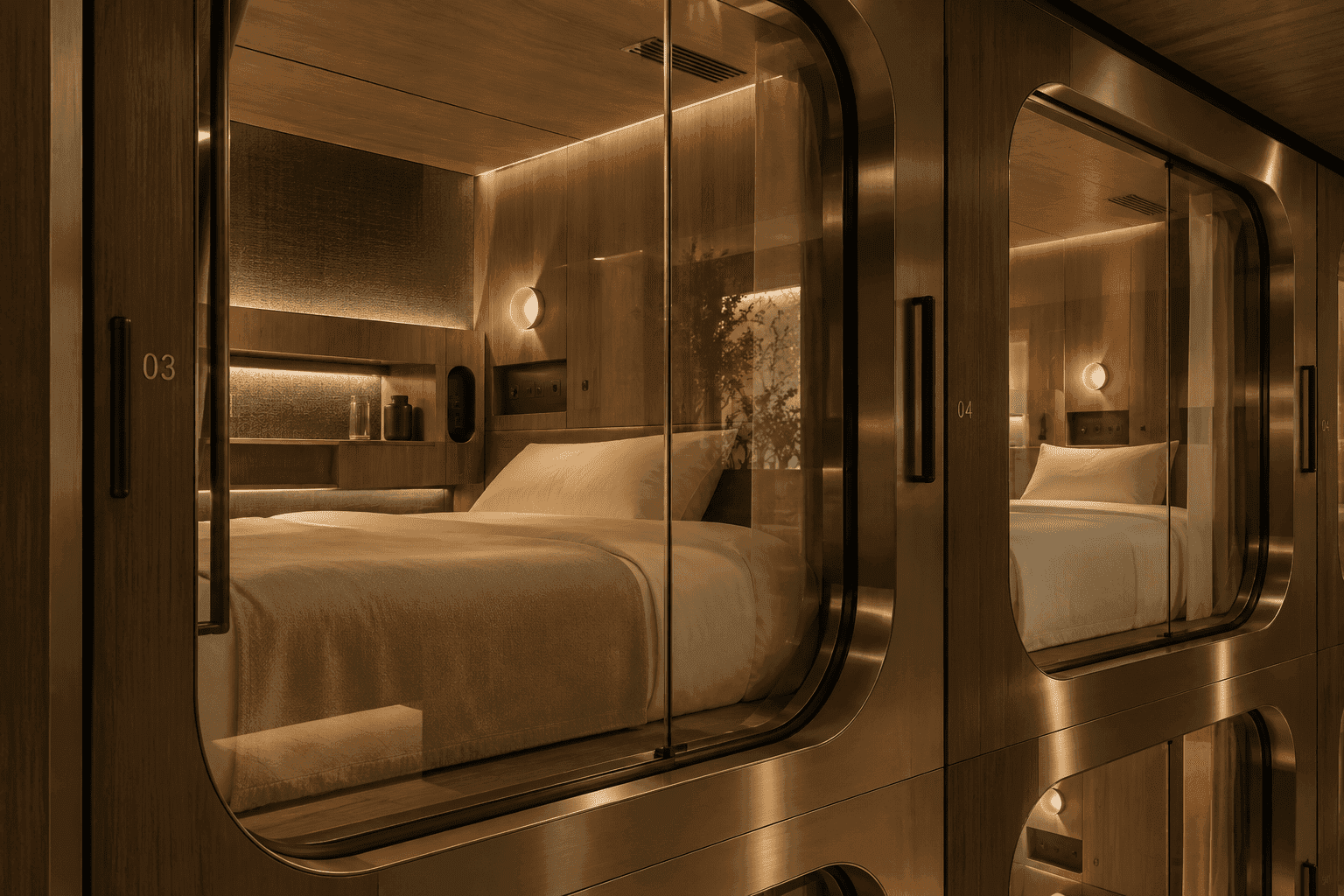
Hotels such as Nine Hours have developed an intentionally minimal visual identity around the concept, while newer properties have incorporated co-working spaces, lounges, sophisticated lighting and technology. The Millennials in Shibuya, for example, introduced larger "SmartPods" combined with shared social and working spaces. Other properties have incorporated traditional Japanese aesthetics, baths, saunas and communal areas into the experience.
This evolution reflects a broader shift in what travellers expect from accommodation.
For decades, hotel quality was closely associated with private space. A larger room, larger bathroom and larger bed generally meant a more expensive and prestigious hotel. Capsule hotels reverse that equation. They reduce the private room to its essential function and invest more heavily in the spaces and services surrounding it.
The capsule itself becomes infrastructure rather than the entire experience.
This is where the concept becomes particularly interesting from a design perspective. Instead of asking how to make a small hotel room feel like a normal hotel room, capsule hotels ask what can be removed without making the accommodation unusable.
The answer is surprisingly much.
A wardrobe can disappear because guests can use lockers. A private bathroom can disappear because bathrooms are shared. A desk can disappear because guests can work elsewhere. A large circulation space can be compressed because the sleeping units can be stacked.
What remains is the bed and the infrastructure necessary to support it.
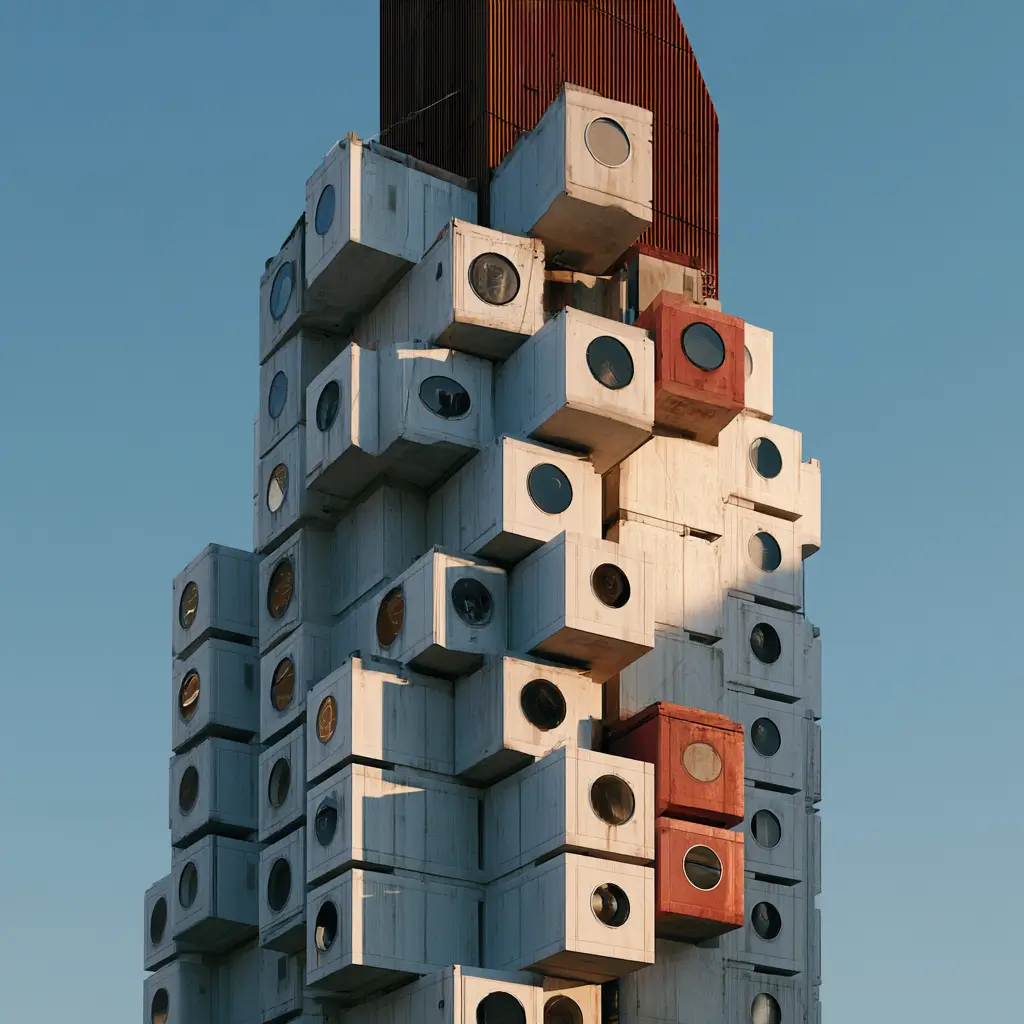
This logic is closely related to Kurokawa’s architectural philosophy. As a member of the Metabolist movement, he was interested in architecture that could be modular, adaptable and capable of changing over time. His Nakagin Capsule Tower in Tokyo, completed in 1972, famously consisted of individual living capsules attached to a larger structural framework. Although the tower was eventually demolished in 2022, it remains one of the most recognisable expressions of Metabolist architecture.
The capsule hotel was not simply an application of this architectural theory, but the connection is revealing. Both concepts treat space as something that can be divided into repeatable units rather than designed exclusively as a single permanent volume.
That modular thinking has since travelled well beyond Japan.
Capsule-style accommodation now exists in airports, hostels and hotels around the world. The basic idea has been adapted to different markets, with some properties prioritising affordability and others turning the capsule into a highly designed experience. Tokyo remains particularly associated with the format because the concept fits naturally within the city's broader culture of compact spaces and highly specialised urban infrastructure.
But the popularity of capsule hotels raises an interesting question: why would travellers voluntarily give up space?
Part of the answer is economic. A capsule can provide access to central locations at a lower price than a conventional private hotel room. Part of it is practical. Solo travellers may have little reason to pay for a room designed for several people when all they actually need is somewhere secure to sleep.
There is also a cultural element. For international visitors, staying in a capsule hotel has become an experience in itself. The format is sufficiently different from conventional Western hospitality that the accommodation becomes part of the trip rather than simply a place to spend the night.
This has created a curious reversal. What originally emerged as an inexpensive and practical solution has become a design object.
The capsule hotel is therefore useful as a case study in how constraints can become cultural products. Limited space was not necessarily treated as something that had to be disguised. Instead, it became the defining feature of the experience.
Tokyo continues to push this idea in different directions. Some capsule hotels remain straightforward and inexpensive. Others increasingly resemble design hotels, with carefully controlled interiors, sophisticated technology, communal lounges and wellness facilities. The category now covers a much wider spectrum than the traditional image of rows of identical sleeping pods.
The phenomenon also says something about the changing economics of cities. As urban land becomes more expensive and travelers become increasingly comfortable with shared infrastructure, the assumption that every guest needs an entirely self-contained room becomes less absolute.
Capsule hotels do not suggest that everyone wants to live in a 90-centimetre-wide sleeping compartment. They demonstrate something more useful: that hospitality can be separated into its component functions, and that those functions do not necessarily have to exist inside the same private space.
That may be the enduring significance of the capsule hotel.
Its innovation was not simply making hotel rooms smaller. It was questioning what a hotel room is actually for.
In Tokyo, the answer was straightforward: if the primary purpose of a hotel room is to sleep, perhaps the room does not need to do much more than that.
More than forty years after the first capsule hotel opened in Osaka, the concept continues to evolve. What began as a practical solution for urban workers has become an international reference point for compact design, modular architecture and alternative hospitality.
The capsule may have been conceived as a way to fit more people into less space. Its lasting influence is the idea that good design does not always begin by adding more. Sometimes it begins by deciding what is unnecessary.
September 24, 2026